
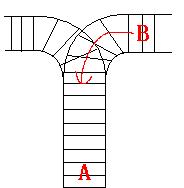
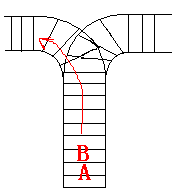
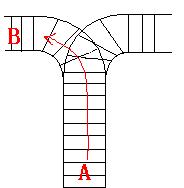
3 123 321
3 123 312
Yes. in in in out out out FINISH No. FINISHFor the first Sample Input, we let train 1 get in, then train 2 and train 3. So now train 3 is at the top of the railway, so train 3 can leave first, then train 2 and train 1. In the second Sample input, we should let train 3 leave first, so we have to let train 1 get in, then train 2 and train 3. Now we can let train 3 leave. But after that we can‘t let train 1 leave before train 2, because train 2 is at the top of the railway at the moment. So we output "No.".HintHint
看到英文题就头痛的啊。。。
于是我就看了输入输出例子 没有读题。。果然wa了。。
只有顶着头皮去看了。。o(︶︿︶)o 唉
给你三个数据 一个是n 表示共有几辆火车,o1是火车的进站顺序,o2是出站顺序,
问按照o1的进站顺序 能不能达到o2的出战顺序。。
用栈模拟火车进出站把、、、
看代码:
#include <stdio.h>
#include <stack>
using namespace std;
int main()
{
	char str[15],str1[15],ch;
	int a[25],n;//a数组1进站0表示出站
	stack<char>s;
	while(scanf("%d",&n)!=EOF)
	{
		scanf("%s",str);
		scanf("%s",str1);
		while(!s.empty())
		s.pop();
		s.push('A');//避免第一次访问栈顶访问到不该访问的地方、、
		int q=0,t=0,flag=0;
		for(int i=0;i<n;i++)
		{
			ch=str1[i];
			if(!flag)
			{
				while(s.top()!=ch&&q<=n)//如果需要出站的火车不在栈顶,继续进火车
				s.push(str[q]),q++,a[t++]=1;
				if(s.top()==ch&&!s.empty())//找到了火车出站
				a[t++]=0,s.pop();
				else//火车进完了还没有找到需要出站的。。
				flag=1;
			}
			if(q==n+1)
			flag=1;
		}
		if(flag)
		printf("No.\nFINISH\n");
		else
		{
			printf("Yes.\n");
			for(int i=0;i<t;i++)
			{
				if(a[i]==1)
				printf("in\n");
				else
				printf("out\n");
			}
			printf("FINISH\n");
		}
	}
	return 0;
}
版权声明:本文为博主原创文章,未经博主允许不得转载。
原文:http://blog.csdn.net/su20145104009/article/details/47292311