
type MyInt int
var i int
var j MyInt
var r io.Reader
var r io.Reader
tty, err := os.OpenFile("/dev/tty", os.O_RDWR, 0)
if err != nil {
    return nil, err
}
r = tty
到这里,r的类型是什么?r的类型仍然是interface io.Reader,只是r = tty这一句,隐含了一个类型转换,将tty转成了io.Reader。
type Binary uint64
func (i Binary) String() string {
    return strconv.Uitob64(i.Get(), 2)
}

func (i Binary) Get() uint64 {
    return uint64(i)
}
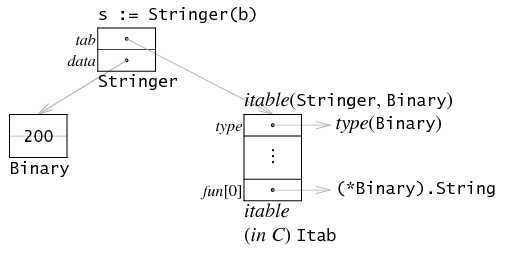
var w io.Writer
    switch v := any.(type) {
    case int:
        return strconv.Itoa(v)
    case float:
        return strconv.Ftoa(v, ‘g‘, -1)
    }
1   var any interface{}  // initialized elsewhere
2   s := any.(Stringer)  // dynamic conversion
3   for i := 0; i < 100; i++ {
4       fmt.Println(s.String())
5   }
143 type iface struct {
144     tab  *itab     // 指南itable
145     data unsafe.Pointer     // 指向真实数据
146 }
617 type itab struct {
618     inter  *interfacetype
619     _type  *_type
620     link   *itab
621     bad    int32
622     unused int32
623     fun    [1]uintptr // variable sized
624 }
310 type imethod struct {
311     name nameOff
312     ityp typeOff
313 }
314
315 type interfacetype struct {
316     typ     _type
317     pkgpath name
318     mhdr    []imethod
319 }
320
 28 type _type struct {
 29     size       uintptr
 30     ptrdata    uintptr // size of memory prefix holding all pointers
 31     hash       uint32
 32     tflag      tflag
 33     align      uint8
 34     fieldalign uint8
 35     kind       uint8
 36     alg        *typeAlg
 37     // gcdata stores the GC type data for the garbage collector.
 38     // If the KindGCProg bit is set in kind, gcdata is a GC program.
 39     // Otherwise it is a ptrmask bitmap. See mbitmap.go for details.
 40     gcdata    *byte
 41     str       nameOff
 42     ptrToThis typeOff
 43 }
 22 func itabhash(inter *interfacetype, typ *_type) uint32 {
 23     // compiler has provided some good hash codes for us.
 24     h := inter.typ.hash
 25     h += 17 * typ.hash
 26     // TODO(rsc): h += 23 * x.mhash ?
 27     return h % hashSize
 28 }
 44     h := itabhash(inter, typ)
 45
 46     // look twice - once without lock, once with.
 47     // common case will be no lock contention.
 48     var m *itab
 49     var locked int
 50     for locked = 0; locked < 2; locked++ {
 51         if locked != 0 {
 52             lock(&ifaceLock)
 53         }
 54         for m = (*itab)(atomic.Loadp(unsafe.Pointer(&hash[h]))); m != nil; m = m.link {
 55             if m.inter == inter && m._type == typ {
 71                 return m    // 找到了前面计算过的itab
 72             }
 73         }
 74     }
 75    // 没有找到,生成一个,并加入到itab的hash中。
 76     m = (*itab)(persistentalloc(unsafe.Sizeof(itab{})+uintptr(len(inter.mhdr)-1)*sys.PtrSize, 0, &memstats.other_sys))
 77     m.inter = inter
 78     m._type = typ
 79     additab(m, true, canfail)
 13 const (
 14     hashSize = 1009
 15 )
 16
 17 var (
 18     ifaceLock mutex // lock for accessing hash
 19     hash      [hashSize]*itab
 20 )
 92     // both inter and typ have method sorted by name,
 93     // and interface names are unique,
 94     // so can iterate over both in lock step;
 95     // the loop is O(ni+nt) not O(ni*nt).       // 按name排序过的,因此这里的匹配只需要O(ni+nt)
 99     j := 0
100     for k := 0; k < ni; k++ {
101         i := &inter.mhdr[k]
102         itype := inter.typ.typeOff(i.ityp)
103         name := inter.typ.nameOff(i.name)
104         iname := name.name()
109         for ; j < nt; j++ {
110             t := &xmhdr[j]
111             tname := typ.nameOff(t.name)
112             if typ.typeOff(t.mtyp) == itype && tname.name() == iname {
118                     if m != nil {
119                         ifn := typ.textOff(t.ifn)
120                         *(*unsafe.Pointer)(add(unsafe.Pointer(&m.fun[0]), uintptr(k)*sys.PtrSize)) = ifn // 找到匹配,将实际类型的方法填入itab的fun
121                     }
122                     goto nextimethod
123                 }
124             }
125         }
135     nextimethod:
136     }
140     h := itabhash(inter, typ)             //插入上面的全局hash
141     m.link = hash[h]
142     atomicstorep(unsafe.Pointer(&hash[h]), unsafe.Pointer(m))
143 }
到这里,interface的数据结构的框架。
原文:http://www.cnblogs.com/qqmomery/p/6298771.html