
| Time Limit: 3000MS | Memory Limit: 65536K | |
| Total Submissions: 10402 | Accepted: 6035 |
Description

Input
Output
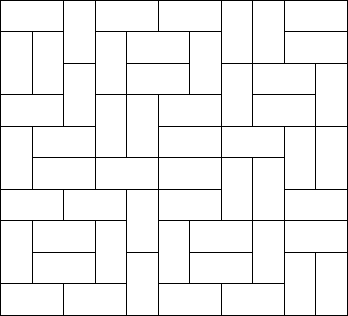 For each test case, output the number of different ways the given rectangle can be filled with small rectangles of size 2 times 1. Assume the given large rectangle
is oriented, i.e. count symmetrical tilings multiple times.
For each test case, output the number of different ways the given rectangle can be filled with small rectangles of size 2 times 1. Assume the given large rectangle
is oriented, i.e. count symmetrical tilings multiple times. Sample Input
1 2
1 3
1 4
2 2
2 3
2 4
2 11
4 11
0 0
Sample Output
1
0
1
2
3
5
144
51205
Source
[Submit] [Go Back] [Status] [Discuss]
给一个长,一个宽,求用1*2的地砖能恰好完全覆盖的方法有多少种。
研究了好久,终于有点理解了,采用状态压缩dp来枚举每一层的状态,然后层层递推,最后就可以得到了答案。
dfs状态压缩代码:
#include <cstdio>
#include <cstring>
#include <cstdlib>
#include <iostream>
using namespace std;
long long dp[12][(1<<11)+1];
int m,n,k;
void dfs(int c,int s1,int s2)
{
	if(c==n)
	{
		dp[k][s1] += dp[k-1][s2];
		return;
	}
	if(c+1<=n)
	{
		dfs(c+1,s1<<1,s2<<1|1);
		dfs(c+1,s1<<1|1,s2<<1);
	}
	if(c+2<=n)
		dfs(c+2,s1<<2|3,s2<<2|3);
}
int main()
{
	while(~scanf("%d%d", &m ,&n) && m)
	{
		if(n>m) swap(n,m);
		memset(dp,0,sizeof(dp));
		dp[0][(1<<n)-1]=1;
		for(k=1; k<=m; k++)
			dfs(0,0,0);
		printf("%lld\n",dp[m][(1<<n)-1]);
	}
    return 0;
}代码:
#include<iostream>
#include<cstring>
using namespace std;
long long f[2][1<<12],i,j,ps,p=0,c=1,n,m;
int main()
{
	while (scanf("%d%d",&n,&m),n!=0)
	{
    	memset(f[c],0,sizeof(f[c]));
    	f[c][(1<<m)-1]=1;
    	for (i=0;i<n;i++)
		for (j=0;j<m;j++)
		{
			swap(p,c);memset(f[c],0,sizeof(f[c]));
			for (ps=0;ps<1<<m;ps++)
			if (f[p][ps])
			{
				if (j>0&&(!(ps&(1<<j-1)))&&(ps&(1<<j))) f[c][ps|1<<(j-1)]+=f[p][ps];
				if (!(ps&1<<j)) f[c][ps|1<<j]+=f[p][ps];
				if (ps&1<<j) f[c][ps^1<<j]+=f[p][ps];
			}
		}
	printf("%lld\n",f[c][(1<<m)-1]);
	}
}
原文:http://blog.csdn.net/xianxingwuguan1/article/details/19039259