
1、 mybatis整体架构
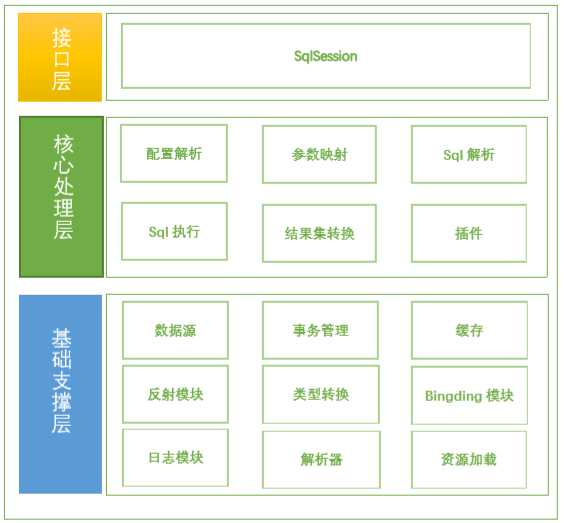
基础支撑层详解
1、日志模块
mybatis日志模块没有实现类,需要接入第三方的组件,问题是第三方的组件有各自的log级别,为了能接入第三方组件,mybati日志模块定义了trace、debug、warn、error级别,然后采取适配器模式将各个日志组件转化为mybatis定义的四种log级别,以此来实现日志模块的接入。Mybatis 会自动扫描日志实现,并且定义了第三方日志组件的加载顺序,加载优先级如下:slfj4-commonLoging-log4J2-log4J-JdkLog
详解自动扫描日志实现和如何实现优先级加载。
先来看一下日志实例的获取流程:框架启动的时候会调用日志模块的LogFactory.getLog()方法来获取log实例,获取到log实例后会设置到configuration对象中。LogFactory.getLog()方法其实就是拿到一个日志实现类的构造器logConstructor,并通过构造器来实例化一个实例进行返回。重点就在这个日志实现类的构造器上,构造器的类型就来源于这个日志实现类的类型。

// getLog(Class<?> aClass)方法
  public static Log getLog(Class<?> aClass) {
    return getLog(aClass.getName());
  }
//通过类构造器实例化实例
  public static Log getLog(String logger) {
    try {
      return logConstructor.newInstance(logger);
    } catch (Throwable t) {
      //如果出现异常,抛出异常,由外层处理
      throw new LogException("Error creating logger for logger " + logger + ".  Cause: " + t, t);
    }
  }
按顺序查找日志实现类:再来看一下构造器logConstructor,在LogFactory第一次初始化的时候执行static 静态代码块,按顺序查找日志实现类,找到就将实现类的构造器赋值。
public final class LogFactory {

  /**
   * Marker to be used by logging implementations that support markers.
   */
  public static final String MARKER = "MYBATIS";
//具体日志实现类的构造器
  private static Constructor<? extends Log> logConstructor;
//按顺序加载
  static {
    tryImplementation(LogFactory::useSlf4jLogging);
    tryImplementation(LogFactory::useCommonsLogging);
    tryImplementation(LogFactory::useLog4J2Logging);
    tryImplementation(LogFactory::useLog4JLogging);
    tryImplementation(LogFactory::useJdkLogging);
    tryImplementation(LogFactory::useNoLogging);
  }
1、启动一个线程去获取构造器
//启动一个线程获取日志实现类的构造器,并设置构造器的值
  private static void tryImplementation(Runnable runnable) {
    if (logConstructor == null) {
      try {
        runnable.run();
      } catch (Throwable t) {
        //捕捉到异常不进行处理
        // ignore
      }
    }
  }
2、查找具体实现类动作
//加载具体的日志实现
  public static synchronized void useSlf4jLogging() {
    setImplementation(org.apache.ibatis.logging.slf4j.Slf4jImpl.class);
  }

  //拿到类构造器,并给类的logConstructor变量赋值,后期getLog()方法将使用logConstructor实例一个日志类实例。
  private static void setImplementation(Class<? extends Log> implClass) {
    try {
      Constructor<? extends Log> candidate = implClass.getConstructor(String.class);
      Log log = candidate.newInstance(LogFactory.class.getName());
      if (log.isDebugEnabled()) {
        log.debug("Logging initialized using ‘" + implClass + "‘ adapter.");
      }
      //赋值
      logConstructor = candidate;
    } catch (Throwable t) {
      throw new LogException("Error setting Log implementation.  Cause: " + t, t);
    }
  }
最后来看一下这个日志实现类org.apache.ibatis.logging.log4j.Log4jImpl.class,其实这个日志实现类就是采用适配器模式,将log4j的日志级别,封装成mybatis的日志级
/**
 *    Copyright ${license.git.copyrightYears} the original author or authors.
 *
 *    Licensed under the Apache License, Version 2.0 (the "License");
 *    you may not use this file except in compliance with the License.
 *    You may obtain a copy of the License at
 *
 *       http://www.apache.org/licenses/LICENSE-2.0
 *
 *    Unless required by applicable law or agreed to in writing, software
 *    distributed under the License is distributed on an "AS IS" BASIS,
 *    WITHOUT WARRANTIES OR CONDITIONS OF ANY KIND, either express or implied.
 *    See the License for the specific language governing permissions and
 *    limitations under the License.
 */
package org.apache.ibatis.logging.slf4j;

import org.apache.ibatis.logging.Log;
import org.slf4j.Logger;
import org.slf4j.LoggerFactory;
import org.slf4j.Marker;
import org.slf4j.spi.LocationAwareLogger;

/**
 * @author Clinton Begin
 * @author Eduardo Macarron
 */
//实现Log 接口,通过slf4j具体实现完成适配
public class Slf4jImpl implements Log {

  private Log log;

  public Slf4jImpl(String clazz) {
    Logger logger = LoggerFactory.getLogger(clazz);

    if (logger instanceof LocationAwareLogger) {
      try {
        // check for slf4j >= 1.6 method signature
        logger.getClass().getMethod("log", Marker.class, String.class, int.class, String.class, Object[].class, Throwable.class);
        log = new Slf4jLocationAwareLoggerImpl((LocationAwareLogger) logger);
        return;
      } catch (SecurityException | NoSuchMethodException e) {
        // fail-back to Slf4jLoggerImpl
      }
    }

    // Logger is not LocationAwareLogger or slf4j version < 1.6
    log = new Slf4jLoggerImpl(logger);
  }

  @Override
  public boolean isDebugEnabled() {
    return log.isDebugEnabled();
  }

  @Override
  public boolean isTraceEnabled() {
    return log.isTraceEnabled();
  }

  @Override
  public void error(String s, Throwable e) {
    log.error(s, e);
  }

  @Override
  public void error(String s) {
    log.error(s);
  }

  @Override
  public void debug(String s) {
    log.debug(s);
  }

  @Override
  public void trace(String s) {
    log.trace(s);
  }

  @Override
  public void warn(String s) {
    log.warn(s);
  }

}
适配器模式详解
适配器模式(Adapter Pattern)是作为两个不兼容的接口之间的桥梁,将一个类的接口转换成客户希望的 另外一个接口。适配器模式使得原本由于接口不兼容而不能一起工作的那些类可以一起工作。
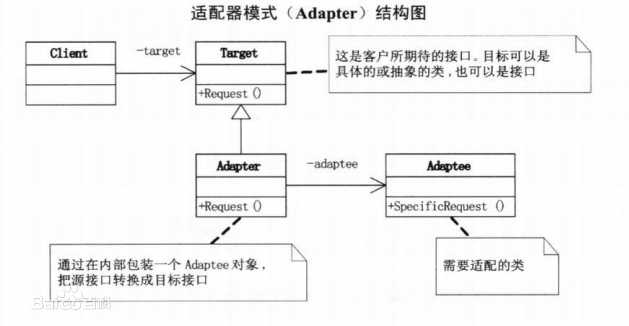
这里引用一个百度百科的图片
角色
Target(目标抽象类):目标抽象类定义客户所需接口,可以是一个抽象类或接口,也可以是具体类。比如:Mybatis 中的Log接口
/**
 *    Copyright ${license.git.copyrightYears} the original author or authors.
 *
 *    Licensed under the Apache License, Version 2.0 (the "License");
 *    you may not use this file except in compliance with the License.
 *    You may obtain a copy of the License at
 *
 *       http://www.apache.org/licenses/LICENSE-2.0
 *
 *    Unless required by applicable law or agreed to in writing, software
 *    distributed under the License is distributed on an "AS IS" BASIS,
 *    WITHOUT WARRANTIES OR CONDITIONS OF ANY KIND, either express or implied.
 *    See the License for the specific language governing permissions and
 *    limitations under the License.
 */
package org.apache.ibatis.logging;

/**
 * @author Clinton Begin
 */
public interface Log {

  boolean isDebugEnabled();

  boolean isTraceEnabled();

  void error(String s, Throwable e);

  void error(String s);

  void debug(String s);

  void trace(String s);

  void warn(String s);

}
Adapter(适配器类):适配器可以调用另一个接口,作为一个转换器,对Adaptee和Target进行适配,适配器类是适配器模式的核心,在对象适配器中,它通过继承Target并关联一个Adaptee对象使二者产生联系。比如Mybatis中的日志模块的实现类org.apache.ibatis.logging.log4j.Log4jImpl.class
/**
 *    Copyright ${license.git.copyrightYears} the original author or authors.
 *
 *    Licensed under the Apache License, Version 2.0 (the "License");
 *    you may not use this file except in compliance with the License.
 *    You may obtain a copy of the License at
 *
 *       http://www.apache.org/licenses/LICENSE-2.0
 *
 *    Unless required by applicable law or agreed to in writing, software
 *    distributed under the License is distributed on an "AS IS" BASIS,
 *    WITHOUT WARRANTIES OR CONDITIONS OF ANY KIND, either express or implied.
 *    See the License for the specific language governing permissions and
 *    limitations under the License.
 */
package org.apache.ibatis.logging.log4j;

import org.apache.ibatis.logging.Log;
import org.apache.log4j.Level;
import org.apache.log4j.Logger;

/**
 * @author Eduardo Macarron
 */
public class Log4jImpl implements Log {

  private static final String FQCN = Log4jImpl.class.getName();

  private final Logger log;

  public Log4jImpl(String clazz) {
    log = Logger.getLogger(clazz);
  }

  @Override
  public boolean isDebugEnabled() {
    return log.isDebugEnabled();
  }

  @Override
  public boolean isTraceEnabled() {
    return log.isTraceEnabled();
  }

  @Override
  public void error(String s, Throwable e) {
    log.log(FQCN, Level.ERROR, s, e);
  }

  @Override
  public void error(String s) {
    log.log(FQCN, Level.ERROR, s, null);
  }

  @Override
  public void debug(String s) {
    log.log(FQCN, Level.DEBUG, s, null);
  }

  @Override
  public void trace(String s) {
    log.log(FQCN, Level.TRACE, s, null);
  }

  @Override
  public void warn(String s) {
    log.log(FQCN, Level.WARN, s, null);
  }

}
Adaptee(适配者类):适配者即被适配的角色,它定义了一个已经存在的接口,这个接口需要适配,适配者类一般是一个具体类,包含了客户希望使用的业务方法,在某些情况下可能没有适配者类的源代码。比如需要被使用的具体日志模块(log4j、log4j2等)
/*
 * Licensed to the Apache Software Foundation (ASF) under one or more
 * contributor license agreements.  See the NOTICE file distributed with
 * this work for additional information regarding copyright ownership.
 * The ASF licenses this file to You under the Apache License, Version 2.0
 * (the "License"); you may not use this file except in compliance with
 * the License.  You may obtain a copy of the License at
 *
 *      http://www.apache.org/licenses/LICENSE-2.0
 *
 * Unless required by applicable law or agreed to in writing, software
 * distributed under the License is distributed on an "AS IS" BASIS,
 * WITHOUT WARRANTIES OR CONDITIONS OF ANY KIND, either express or implied.
 * See the License for the specific language governing permissions and
 * limitations under the License.
 */

package org.apache.log4j;

import org.apache.log4j.spi.LoggerFactory;


/**
  This is the central class in the log4j package. Most logging
  operations, except configuration, are done through this class.

  @since log4j 1.2

  @author Ceki Gülcü */
public class Logger extends Category {

  /**
     The fully qualified name of the Logger class. See also the
     getFQCN method. */
  private static final String FQCN = Logger.class.getName();


  protected
  Logger(String name) {
    super(name);
  }

  /**
    Log a message object with the {@link Level#FINE FINE} level which
    is just an alias for the {@link Level#DEBUG DEBUG} level.

    <p>This method first checks if this category is <code>DEBUG</code>
    enabled by comparing the level of this category with the {@link
    Level#DEBUG DEBUG} level. If this category is
    <code>DEBUG</code> enabled, then it converts the message object
    (passed as parameter) to a string by invoking the appropriate
    {@link org.apache.log4j.or.ObjectRenderer}. It then proceeds to call all the
    registered appenders in this category and also higher in the
    hierarchy depending on the value of the additivity flag.

    <p><b>WARNING</b> Note that passing a {@link Throwable} to this
    method will print the name of the <code>Throwable</code> but no
    stack trace. To print a stack trace use the {@link #debug(Object,
    Throwable)} form instead.

    @param message the message object to log. */
  //public
  //void fine(Object message) {
  //  if(repository.isDisabled(Level.DEBUG_INT))
  //    return;
  //  if(Level.DEBUG.isGreaterOrEqual(this.getChainedLevel())) {
  //    forcedLog(FQCN, Level.DEBUG, message, null);
  //  }
  //}


  /**
   Log a message object with the <code>FINE</code> level including
   the stack trace of the {@link Throwable} <code>t</code> passed as
   parameter.

   <p>See {@link #fine(Object)} form for more detailed information.

   @param message the message object to log.
   @param t the exception to log, including its stack trace.  */
  //public
  //void fine(Object message, Throwable t) {
  //  if(repository.isDisabled(Level.DEBUG_INT))
  //    return;
  //  if(Level.DEBUG.isGreaterOrEqual(this.getChainedLevel()))
  //    forcedLog(FQCN, Level.FINE, message, t);
  //}

  /**
   * Retrieve a logger named according to the value of the
   * <code>name</code> parameter. If the named logger already exists,
   * then the existing instance will be returned. Otherwise, a new
   * instance is created.
   *
   * <p>By default, loggers do not have a set level but inherit it
   * from their neareast ancestor with a set level. This is one of the
   * central features of log4j.
   *
   * @param name The name of the logger to retrieve.
  */
  static
  public
  Logger getLogger(String name) {
    return LogManager.getLogger(name);
  }

  /**
   * Shorthand for <code>getLogger(clazz.getName())</code>.
   *
   * @param clazz The name of <code>clazz</code> will be used as the
   * name of the logger to retrieve.  See {@link #getLogger(String)}
   * for more detailed information.
   */
  static
  public
  Logger getLogger(Class clazz) {
    return LogManager.getLogger(clazz.getName());
  }


  /**
   * Return the root logger for the current logger repository.
   * <p>
   * The {@link #getName Logger.getName()} method for the root logger always returns
   * string value: "root". However, calling
   * <code>Logger.getLogger("root")</code> does not retrieve the root
   * logger but a logger just under root named "root".
   * <p>
   * In other words, calling this method is the only way to retrieve the
   * root logger.
   */
  public
  static
  Logger getRootLogger() {
    return LogManager.getRootLogger();
  }

  /**
     Like {@link #getLogger(String)} except that the type of logger
     instantiated depends on the type returned by the {@link
     LoggerFactory#makeNewLoggerInstance} method of the
     <code>factory</code> parameter.

     <p>This method is intended to be used by sub-classes.

     @param name The name of the logger to retrieve.

     @param factory A {@link LoggerFactory} implementation that will
     actually create a new Instance.

     @since 0.8.5 */
  public
  static
  Logger getLogger(String name, LoggerFactory factory) {
    return LogManager.getLogger(name, factory);
  }

    /**
     * Log a message object with the {@link org.apache.log4j.Level#TRACE TRACE} level.
     *
     * @param message the message object to log.
     * @see #debug(Object) for an explanation of the logic applied.
     * @since 1.2.12
     */
    public void trace(Object message) {
      if (repository.isDisabled(Level.TRACE_INT)) {
        return;
      }

      if (Level.TRACE.isGreaterOrEqual(this.getEffectiveLevel())) {
        forcedLog(FQCN, Level.TRACE, message, null);
      }
    }

    /**
     * Log a message object with the <code>TRACE</code> level including the
     * stack trace of the {@link Throwable}<code>t</code> passed as parameter.
     *
     * <p>
     * See {@link #debug(Object)} form for more detailed information.
     * </p>
     *
     * @param message the message object to log.
     * @param t the exception to log, including its stack trace.
     * @since 1.2.12
     */
    public void trace(Object message, Throwable t) {
      if (repository.isDisabled(Level.TRACE_INT)) {
        return;
      }

      if (Level.TRACE.isGreaterOrEqual(this.getEffectiveLevel())) {
        forcedLog(FQCN, Level.TRACE, message, t);
      }
    }

    /**
     * Check whether this category is enabled for the TRACE  Level.
     * @since 1.2.12
     *
     * @return boolean - <code>true</code> if this category is enabled for level
     *         TRACE, <code>false</code> otherwise.
     */
    public boolean isTraceEnabled() {
        if (repository.isDisabled(Level.TRACE_INT)) {
            return false;
          }

          return Level.TRACE.isGreaterOrEqual(this.getEffectiveLevel());
    }

}
适用场景:当调用双方都不太容易修改的时候,为了复用现有组件可以使用适配器模式;在系统中接入第三方组 件的时候经常被使用到。
原文:https://www.cnblogs.com/pianzhi/p/11438464.html
