
C语言中的一切操作都是基于内存的
变量和数组都是内存的别名
需求:程序运行的过程中,可能需要使用一些额外的内存空间
malloc 和 free 用于执行动态分配内存和释放
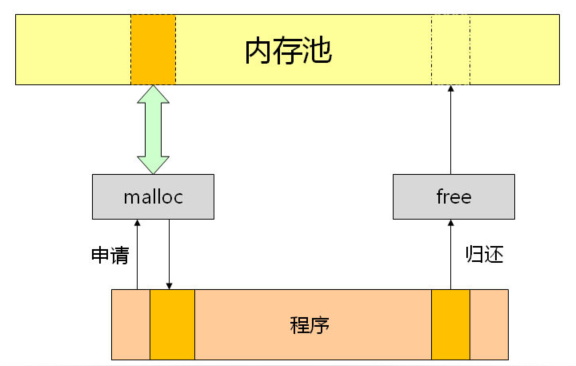
malloc 所分配的是一块连续的内存
malloc 以字节为单位,并且不带任何的类型信息
free 用于将动态内存归还系统
void* malloc(size_t size);
void free(void* pointer);
注意
malloc 和 free 是库函数,而不是系统调用malloc 实际分配的内存可能会比请求的多malloc 行为——为了移植性malloc 返回 NULLfree 的参数为 NULL 时,函数直接返回问题1:malloc(0); 将会返回什么?
Demo
#include <stdio.h>
#include <malloc.h>

int main()
{
    int* p  = (int*)malloc(0);

    printf("p = %p\n",p);

    free(p);

    return 0;
}
运行结果 => malloc(0)是合法的,但申请的内存长度为0
p = 0x895a008
问题2:如果不断地执行 malloc(0); 但是不进行内存释放,会产生内存泄漏么?
malloc 实际分配的内存可能会比请求的多,malloc(0); 可能得到的内存是 4 个字节大小实例:内存泄漏检测模块
Demo
#include <stdio.h>
#include "mleak.h"

void f()
{
    MALLOC(100);  //自定义的malloc函数,这里没有进行内存释放
}

int main()
{
    int* p = (int*)MALLOC(3 * sizeof(int));

    f();

    p[0] = 1;
    p[1] = 2;
    p[2] = 3;

    FREE(p);  //自定义的free函数

    PRINT_LEAK_INFO();  //打印当前内存泄漏的信息

    return 0;
}


//mleak.h
#ifndef _MLEAK_H_
#define _MLEAK_H_

#include <malloc.h>

#define MALLOC(n) mallocEx(n, __FILE__, __LINE__)
#define FREE(p) freeEx(p)

void* mallocEx(size_t n, const char* file, const line);
void freeEx(void* p);
void PRINT_LEAK_INFO();

#endif

//mleak.c
#include "mleak.h"

#define SIZE 256

/* 动态内存申请参数结构体 */
typedef struct
{
    void* pointer;
    int size;
    const char* file;
    int line;
} MItem;

static MItem g_record[SIZE]; /* 记录动态内存申请的操作 */

void* mallocEx(size_t n, const char* file, const line)
{
    void* ret = malloc(n); /* 动态内存申请 */

    if( ret != NULL )
    {
        int i = 0;

        /* 遍历全局数组,记录此次操作 */
        for(i=0; i<SIZE; i++)
        {
            /* 查找位置 */
            if( g_record[i].pointer == NULL )
            {
                g_record[i].pointer = ret;
                g_record[i].size = n;
                g_record[i].file = file;
                g_record[i].line = line;
                break;
            }
        }
    }

    return ret;
}

void freeEx(void* p)
{
    if( p != NULL )
    {
        int i = 0;

        /* 遍历全局数组,释放内存空间,并清除操作记录 */
        for(i=0; i<SIZE; i++)
        {
            if( g_record[i].pointer == p )
            {
                g_record[i].pointer = NULL;
                g_record[i].size = 0;
                g_record[i].file = NULL;
                g_record[i].line = 0;

                free(p);

                break;
            }
        }
    }
}

void PRINT_LEAK_INFO()
{
    int i = 0;

    printf("Potential Memory Leak Info:\n");

    /* 遍历全局数组,打印未释放的空间记录 */
    for(i=0; i<SIZE; i++)
    {
        if( g_record[i].pointer != NULL )
        {
            printf("Address: %p, size:%d, Location: %s:%d\n", g_record[i].pointer, g_record[i].size, g_record[i].file, g_record[i].line);
        }
    }
}
运行
malloc 的同胞兄弟
void* calloc(size_t num,size_t size);
void* realloc(void* pointer,size_t new_size);
calloc 的参数代表所返回内存的类型信息
calloc 会将返回的内存初始化为0
realloc 用于修改一个原先已经分配的内存块大小
realloc 之后应该使用其返回值pointer 的**第一个参数为 NULL 时,等价于 malloc **对比
malloc 单纯地从系统中申请固定字节大小的内存calloc 能以类型大小为单位申请内存并初始化为0realloc 用于重置内存大小,如果内存重置为一个更大的内存空间,扩充的部分为随机值示例:calloc 和 realloc 的使用
Demo
#include <stdio.h>
#include <malloc.h>

#define SIZE 5

int main()
{
    int i = 0;
    int* pI = (int*)malloc(SIZE * sizeof(int));
    short* pS = (short*)calloc(SIZE, sizeof(short));

    for(i=0; i<SIZE; i++)
    {
        printf("pI[%d] = %d, pS[%d] = %d\n", i, pI[i], i, pS[i]);
    }

    printf("Before: pI = %p\n", pI);

    pI = (int*)realloc(pI, 2 * SIZE * sizeof(int));

    printf("After: pI = %p\n", pI);

    for(i=0; i<10; i++)
    {
        printf("pI[%d] = %d\n", i, pI[i]);
    }

    free(pI);
    free(pS);

    return 0;
}
GCC 编译运行
pI[0] = 0,pS[0] = 0
pI[1] = 0,pS[1] = 0
pI[2] = 0,pS[2] = 0
pI[3] = 0,pS[3] = 0
pI[4] = 0,pS[4] = 0
Before : pI = 0x9241008
After : pI = 0x9241438
pI[0] = 0
pI[1] = 0
pI[2] = 0
pI[3] = 0
pI[4] = 0
pI[5] = 0
pI[6] = 0
pI[7] = 0
pI[8] = 0
pI[9] = 0
VS 编译运行
pI[0] = -842150451, pS[0] = 0
pI[1] = -842150451, pS[1] = 0
pI[2] = -842150451, pS[2] = 0
pI[3] = -842150451, pS[3] = 0
pI[4] = -842150451, pS[4] = 0
Before: pI = 014B5650
After: pI = 014B5650
pI[0] = -842150451
pI[1] = -842150451
pI[2] = -842150451
pI[3] = -842150451
pI[4] = -842150451
pI[5] = -842150451
pI[6] = -842150451
pI[7] = -842150451
pI[8] = -842150451
pI[9] = -842150451
原文:https://www.cnblogs.com/bky-hbq/p/13773697.html