
针孔成像模型是整个计算视觉的基石,个人认为无论从事计算视觉哪个子领域的研究,都应学习学习针孔成像模型这一理论。
学习针孔成像模型最好的资料莫过于OpenCV中的cv::ProjectPoints,此函数不仅实现了针孔成像模型,而且还实现了每个像素坐标对投影参数、畸变参数及投影外参的偏导数,即像素坐标对这些参数的Jacobian矩阵。
针孔成像模型及cv::ProjectPoints实现原理,如下图所示。
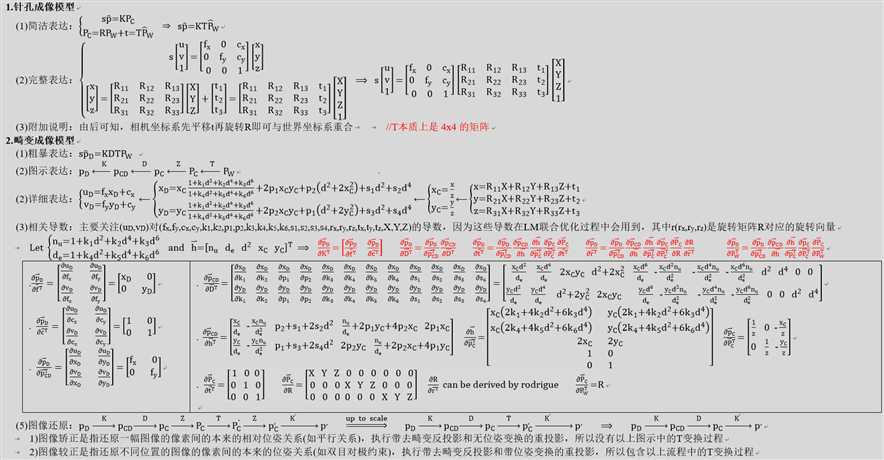
cv::ProjectPoints不足之处是对投影外参的偏导数和投影内参都采用了相同的求导法则,当只想计算对投影外参的偏导数时,这种求导方式计算量过大。
根据李代数的相关理论可知,对外参的导数(即旋转和平移)有三种实现:
(1)基于指数映射求导
(2)基于BCH公式求导
(3)基于扰动方式求导
以上三种求导方式,计算量依次递减。其中,基于扰动方式求导是视觉定位中最常使用的。
为此,我参考相关书籍,在cv::ProjectPoints的基础上增加了另外两种求导方式,并进行了测试验证。
以下是详细代码,依赖于C++14、OpenCV4.x和Spdlog。

  1 #include <opencv2/opencv.hpp>
  2 #include <spdlog/spdlog.h>
  3 using namespace std;
  4 using namespace cv;
  5
  6 class ProjectPointsEx
  7 {
  8 public:
  9     using Mat121d = Matx<double, 12, 1>;
 10     static void TestMe(int argc = 0, char** argv = 0)
 11     {
 12         int N = 999;
 13         for (int k = 0; k < N; ++k)
 14         {
 15             Mat_<Vec3d> PWs(999, 1); cv::randu(PWs, 1111, 9999);
 16             Matx33d K = K.randu(111, 999); K(0, 1) = K(1, 0) = K(2, 0) = K(2, 1) = 0.; K(2, 2) = 1;
 17             Mat121d D = D.randu(0.1, 0.9);
 18             Matx31d r = r.randu(11, 99);
 19             Matx31d t = t.randu(111, 999);
 20
 21             //2.CalcByOpenCV
 22             Mat p1s;
 23             Mat_<double> dpdKDT1;
 24             cv::projectPoints(PWs, r, t, K, D, p1s, dpdKDT1);
 25
 26             //3.CalcByDIY
 27             Mat_<Matx21d> p2s(PWs.size());
 28             Mat_<double> _dpdKDT2[5], dpdKDT2;//dpdf1/dpdc1/dpdd1/dpdr1/dpdt1;
 29             ProjectPointsEx::run(PWs, r, t, K, D, p2s, _dpdKDT2, _dpdKDT2 + 1, _dpdKDT2 + 2, _dpdKDT2 + 3, _dpdKDT2 + 4);
 30             hconcat(_dpdKDT2, 5, dpdKDT2);
 31
 32             //4.AnalyzeError
 33             double infps1ps2 = norm(p1s, p2s, NORM_INF);
 34             double infdpdKDT1dpdKDT2 = norm(dpdKDT1, dpdKDT2, NORM_INF);
 35
 36             //5.PrintError
 37             cout << endl << "LoopCount: " << k << endl;
 38             if (infps1ps2 > 0 || infdpdKDT1dpdKDT2 > 0)
 39             {
 40                 cout << endl << "5.1PrintError" << endl;
 41                 cout << endl << "infps1ps2: " << infps1ps2 << endl;
 42                 cout << endl << "infdpdKDT1dpdKDT2: " << infdpdKDT1dpdKDT2 << endl;
 43                 if (0)
 44                 {
 45                     cout << endl << "5.2PrintDiff" << endl;
 46                     cout << endl << "dpdKDT1: " << endl << dpdKDT1.t() << endl;
 47                     cout << endl << "dpdKDT2: " << endl << dpdKDT2.t() << endl;
 48                     cout << endl << "p1s: " << endl << p1s << endl;
 49                     cout << endl << "p2s: " << endl << p2s << endl;
 50                     cout << endl << "5.3PrintOthers" << endl;
 51                     cout << endl << "PWs: " << endl << PWs << endl;
 52                     cout << endl << "K: " << endl << K << endl;
 53                     cout << endl << "D: " << endl << D.t() << endl;
 54                     //cout << endl << "r-degree: " << endl << r.t() << endl << degree.t() << endl;
 55                     cout << endl << "t: " << endl << t.t() << endl;
 56                 }
 57                 cout << endl << "Press any key to continue" << endl;
 58                 std::getchar();
 59             }
 60         }
 61     }
 62
 63 public:
 64     static void run(Mat_<Matx31d> PWs, Matx31d r, Matx31d t, Matx33d K, Mat121d D, Mat_<Matx21d>& pDs,
 65         Mat_<double>* dpdr = 0, Mat_<double>* dpdt = 0, Mat_<double>* dpdF = 0, Mat_<double>* dpdC = 0, Mat_<double>* dpdD = 0, Mat_<double>* dpdPW = 0,
 66         bool fixFxFyRatio = false, int derivRotWay = 0)
 67     {
 68         //1.Projection params
 69         double fx = K.val[0];
 70         double fy = K.val[4];
 71         double cx = K.val[2];
 72         double cy = K.val[5];
 73
 74         //2.Distortion params
 75         double k1 = D.val[0];
 76         double k2 = D.val[1];
 77         double p1 = D.val[2];
 78         double p2 = D.val[3];
 79         double k3 = D.val[4];
 80         double k4 = D.val[5];
 81         double k5 = D.val[6];
 82         double k6 = D.val[7];
 83         double s1 = D.val[8];
 84         double s2 = D.val[9];
 85         double s3 = D.val[10];
 86         double s4 = D.val[11];
 87         //double a = D.val[12],  b = D.val[13];
 88
 89         //3.Translation params
 90         double tx = t.val[0];
 91         double ty = t.val[1];
 92         double tz = t.val[2];
 93
 94         //4.Rotation params
 95         Matx33d R;
 96         Mat_<double> _dRdr; cv::Rodrigues(r, R, dpdr ? _dRdr : noArray());
 97         _dRdr = _dRdr.t(); Matx<double, 9, 3> dRdr; if (dpdr) memcpy(dRdr.val, _dRdr.ptr<double>(), sizeof(dRdr));
 98
 99         //5.ReProjection
100         for (int k = 0; k < PWs.total(); ++k)
101         {
102             //5.1 WorldCoordinate
103             double X = PWs(k)(0);
104             double Y = PWs(k)(1);
105             double Z = PWs(k)(2);
106
107             //5.2 CameraCoordinate
108             double x = R.val[0] * X + R.val[1] * Y + R.val[2] * Z + tx;
109             double y = R.val[3] * X + R.val[4] * Y + R.val[5] * Z + ty;
110             double z = R.val[6] * X + R.val[7] * Y + R.val[8] * Z + tz;
111
112             //5.3 StandardPhysicsCoordinate
113             double iz = z ? 1. / z : 1;
114             double xc = x * iz;
115             double yc = y * iz;
116
117             //5.4 DistortionPhysicsCoordinate
118             double xc2 = xc * xc;
119             double yc2 = yc * yc;
120             double d2 = xc2 + yc2;
121             double xcyc = 2 * xc * yc;
122             double d4 = d2 * d2;
123             double d6 = d2 * d4;
124             double d2xc2 = d2 + 2 * xc2;
125             double d2yc2 = d2 + 2 * yc2;
126             double nu = 1 + k1 * d2 + k2 * d4 + k3 * d6;
127             double de = 1. / (1 + k4 * d2 + k5 * d4 + k6 * d6);
128             double xd = xc * nu * de + p1 * xcyc + p2 * d2xc2 + s1 * d2 + s2 * d4;
129             double yd = yc * nu * de + p2 * xcyc + p1 * d2yc2 + s3 * d2 + s4 * d4;
130
131             //5.5 DistortionPixelCoordinate
132             pDs(k) = Matx21d(xd * fx + cx, yd * fy + cy);
133
134             //5.6 dpdF: derivatives with respect to the focal lengths
135             if (dpdF)
136             {
137                 if (dpdF->empty()) dpdF->create(PWs.rows << 1, 2);
138                 double* ptr = dpdF->ptr<double>(k << 1);
139                 ptr[0] = xd; ptr[1] = 0;
140                 ptr[2] = 0; ptr[3] = yd;
141             }
142
143             //5.7 dpdC: derivatives with respect to the principal point
144             if (dpdC)
145             {
146                 if (dpdC->empty()) dpdC->create(PWs.rows << 1, 2);
147                 double* ptr = dpdC->ptr<double>(k << 1);
148                 ptr[0] = 1.; ptr[1] = 0;
149                 ptr[2] = 0; ptr[3] = 1.;
150             }
151
152             //5.8 dpdD: derivatives with respect to the distortion coefficients
153             if (dpdD)
154             {
155                 if (dpdD->empty()) dpdD->create(PWs.rows << 1, 12);
156                 double* ptr = dpdD->ptr<double>(k << 1);
157
158                 Matx22d dpDdpCD; dpDdpCD <<
159                     fx, 0,
160                     0, fy;
161
162                 Matx<double, 2, 12> dpCDdD; dpCDdD <<
163                     xc * d2 * de, xc* d4* de, xcyc, d2xc2, xc* d6* de, -xc * d2 * nu * de * de, -xc * d4 * nu * de * de, -xc * d6 * nu * de * de, d2, d4, 0, 0,
164                     yc* d2* de, yc* d4* de, d2yc2, xcyc, yc* d6* de, -yc * d2 * nu * de * de, -yc * d4 * nu * de * de, -yc * d6 * nu * de * de, 0, 0, d2, d4;
165
166                 Matx<double, 2, 12> dpDdD = dpDdpCD * dpCDdD;
167                 memcpy(ptr, dpDdD.val, 24 * sizeof(double));
168             }
169
170             //5.9 dpdr&dpdt: derivatives with respect to the pose
171             if (dpdr || dpdt || dpdPW)
172             {
173                 Matx22d dpDdpCD;
174                 dpDdpCD << fx, 0, 0, fy;
175
176                 Matx<double, 2, 5> dpCDdh; dpCDdh <<
177                     xc * de, -xc * nu * de * de, p2 + s1 + 2 * s2 * d2, nu* de + 2 * p1 * yc + 4 * p2 * xc, 2 * p1 * xc,
178                     yc* de, -yc * nu * de * de, p1 + s3 + 2 * s4 * d2, 2 * p2 * yc, nu* de + 2 * p2 * xc + 4 * p1 * yc;
179
180                 Matx<double, 5, 2> dhdpC; dhdpC <<
181                     xc * (2 * k1 + 4 * k2 * d2 + 6 * k3 * d4), yc* (2 * k1 + 4 * k2 * d2 + 6 * k3 * d4),
182                     xc* (2 * k4 + 4 * k5 * d2 + 6 * k6 * d4), yc* (2 * k4 + 4 * k5 * d2 + 6 * k6 * d4),
183                     2 * xc, 2 * yc,
184                     1, 0,
185                     0, 1;
186
187                 Matx23d dpCdPC; dpCdPC <<
188                     iz, 0, -xc * iz,
189                     0, iz, -yc * iz;
190
191                 if (dpdt)//dpdt: derivatives with respect to the translation vector
192                 {
193                     if (dpdt->empty()) dpdt->create(PWs.rows << 1, 3);
194                     double* ptr = dpdt->ptr<double>(k << 1);
195
196                     Matx23d dpDdt = dpDdpCD * dpCDdh * dhdpC * dpCdPC;
197                     memcpy(ptr, dpDdt.val, 6 * sizeof(double));
198                 }
199
200                 if (dpdr)//dpdr: derivatives with respect to the rotation vector
201                 {
202                     if (dpdr->empty()) dpdr->create(PWs.rows << 1, 3);
203                     double* ptr = dpdr->ptr<double>(k << 1);
204
205                     Matx23d dpDdr;
206                     if (derivRotWay == 0)//(1)by exponential map
207                     {
208                         Matx<double, 3, 9> dPCdR; dPCdR <<
209                             X, Y, Z, 0, 0, 0, 0, 0, 0,
210                             0, 0, 0, X, Y, Z, 0, 0, 0,
211                             0, 0, 0, 0, 0, 0, X, Y, Z;
212                         dpDdr = dpDdpCD * dpCDdh * dhdpC * dpCdPC * dPCdR * dRdr;
213                     }
214                     else
215                     {
216                         Matx33d _skewPC
217                         (
218                             0, (z - tz), -(y - ty),
219                             -(z - tz), 0, (x - tx),
220                             (y - ty), -(x - tx), 0
221                         );
222                         if (derivRotWay == 1)//(2)by BCH formula
223                         {
224                             double theta = sqrt(r.val[0] * r.val[0] + r.val[1] * r.val[1] + r.val[2] * r.val[2]);
225                             double itheta = 1 / theta;
226                             double sn = sin(theta);
227                             double cs1 = 1 - cos(theta);
228                             Matx31d n(r.val[0] * itheta, r.val[1] * itheta, r.val[2] * itheta);
229                             Matx33d nskew(0, -n.val[2], n.val[1], n.val[2], 0, -n.val[0], -n.val[1], n.val[0], 0);
230                             Matx33d Jl = itheta * sn * Matx33d::eye() + itheta * cs1 * nskew + (1 - itheta * sn) * n * n.t();
231                             dpDdr = dpDdpCD * dpCDdh * dhdpC * dpCdPC * _skewPC * Jl;
232                         }
233                         else if (derivRotWay == 2) dpDdr = dpDdpCD * dpCDdh * dhdpC * dpCdPC * _skewPC; //(3)by perturbance for reduced LocalParameterization of ceresSolver
234                     }
235
236                     memcpy(ptr, dpDdr.val, 6 * sizeof(double));
237
238                     if (derivRotWay == 3) //(4)by perturbance for general LocalParameterization of ceresSolver
239                     {
240                         if (dpdr->empty() || dpdr->cols != 9) dpdr->create(PWs.rows << 1, 9);
241                         double* ptr = dpdr->ptr<double>(k << 1);
242                         Matx<double, 3, 9> dPCdR; dPCdR <<
243                             X, Y, Z, 0, 0, 0, 0, 0, 0,
244                             0, 0, 0, X, Y, Z, 0, 0, 0,
245                             0, 0, 0, 0, 0, 0, X, Y, Z;
246                         Matx<double, 2, 9> dpDdR = dpDdpCD * dpCDdh * dhdpC * dpCdPC * dPCdR;
247                         memcpy(ptr, dpDdR.val, 18 * sizeof(double));
248                     }
249                 }
250
251                 if (dpdPW)//dpdPW: derivatives with respect to the worldcoordinate
252                 {
253                     if (dpdPW->empty()) dpdPW->create(PWs.rows << 1, 3);
254                     double* ptr = dpdPW->ptr<double>(k << 1);
255
256                     Matx23d dpDdPW = dpDdpCD * dpCDdh * dhdpC * dpCdPC * R;
257                     memcpy(ptr, dpDdPW.val, 6 * sizeof(double));
258                 }
259             }
260         }
261     }
262 };
263
264 int main(int argc, char** argv) { ProjectPointsEx::TestMe(argc, argv); return 0; }
OpenCV-Ima3D学习日志:ProjectPoints分析与实现
原文:https://www.cnblogs.com/dzyBK/p/13934461.html
