
1:配置数据源,如:
|
1
2
3
4
5
6
7
8
9
10
11
12
13
14
15
16
17
18
19
20
21
22
23
24
25
26
27
28
29
30 |
<beans xmlns="http://www.springframework.org/schema/beans" xsi:schemaLocation="http://www.springframework.org/schema/beans http://www.springframework.org/schema/beans/spring-beans-2.5.xsd http://www.springframework.org/schema/aop http://www.springframework.org/schema/aop/spring-aop-2.5.xsd http://www.springframework.org/schema/context http://www.springframework.org/schema/context/spring-context-2.5.xsd"> <!-- 配置数据源 --> <bean id="dataSource"
class="org.apache.commons.dbcp.BasicDataSource"
destroy-method="close"> <property name="driverClassName"
value="org.gjt.mm.mysql.Driver"/> <property name="url"
value="jdbc:mysql://localhost:3306/itcast?useUnicode=true&characterEncoding=UTF-8"/> <property name="username"
value="root"/> <property name="password"
value="1"/> <!-- 连接池启动时的初始值 --> <property name="initialSize"
value="1"/> <!-- 连接池的最大值 --> <property name="maxActive"
value="500"/> <!-- 最大空闲值.当经过一个高峰时间后,连接池可以慢慢将已经用不到的连接慢慢释放一部分,一直减少到maxIdle为止 --> <property name="maxIdle"
value="2"/> <!-- 最小空闲值.当空闲的连接数少于阀值时,连接池就会预申请去一些连接,以免洪峰来时来不及申请 --> <property name="minIdle"
value="1"/> </bean> </beans> |
这一步完成之后我们可以进行数据的增删改查操作啦。
注意使用到的Jar包
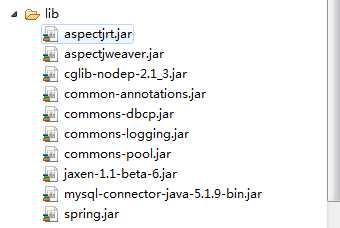
写实体bean, 以及servive 层, 然后再xml中配置bean 以及为bean配置数据源;
|
1
2
3 |
<bean class="cn.gbx.service.impl.PersonServiceImpl"
id="personServiceImpl"> <property name="dataSource"
ref="dataSource"></property> </bean> |
|
1
2
3
4
5
6
7
8
9
10
11
12
13
14
15
16
17
18
19
20
21
22
23
24
25
26
27
28
29
30
31
32
33
34
35
36
37
38
39
40
41
42
43
44
45
46
47
48
49
50
51
52
53
54
55 |
package cn.gbx.service.impl;import java.util.List;import javax.sql.DataSource;import org.springframework.jdbc.core.JdbcTemplate;import cn.gbx.bean.Person;import cn.gbx.service.IPersonService;<br>@Transactionalpublic
class PersonServiceImpl implements IPersonService { private
JdbcTemplate jdbcTemplate; //通过DI将数据源注入给jdbcTemplate public
void setDataSource(DataSource dataSource) { this.jdbcTemplate = new
JdbcTemplate(dataSource); } @Override public
void save(Person person) { jdbcTemplate.update("insert into t_person(name) values(?)", new
Object[] {person.getName()}, new
int[] {java.sql.Types.VARCHAR}); } @Override public
void delte(Person person) { jdbcTemplate.update("delete from t_person where id = ?", new
Object[] {person.getId()}, new
int[] {java.sql.Types.INTEGER}); } @Override public
void update(Person person) { jdbcTemplate.update("update t_person set name = ? where id = ?", new
Object[] {person.getName(), person.getId()}, new
int[]{java.sql.Types.VARCHAR, java.sql.Types.VARCHAR} ); } @Override public
Person getPerson(Integer personid) { Person person = (Person)jdbcTemplate.queryForObject("select * from t_person where id = ?", new
Object[] {personid}, new
int[] {java.sql.Types.INTEGER} , new
PersonHandler()); return
person; } @Override public
List<Person> getPersons() { List<Person> persons = null; persons = jdbcTemplate.query("select * from t_person", new
PersonHandler()); return
persons; }} |
2:配置事务。配置事务时,需要在xml配置文件中引入用于声明事务的tx命名空间,事务的配置方式有两种:注解方式和基于XML配置方式。
在spring配置文件中引入用于声明事务的tx命名空间
采用注解方式配置事务:
<bean id="txManager" class="org.springframework.jdbc.datasource.DataSourceTransactionManager">
<property name="dataSource" ref="dataSource"/>
</bean>
<!– 采用@Transactional注解方式使用事务 -->
<tx:annotation-driven transaction-manager="txManager"/>
@Service @Transactional
public class PersonServiceBean implements PersonService {
}
采用基于XML方式配置事务
|
1
2
3
4
5
6
7
8
9
10
11
12
13 |
<bean id="txManager"
class="org.springframework.jdbc.datasource.DataSourceTransactionManager"> <property name="dataSource"
ref="dataSource"/></bean><aop:config> <aop:pointcut id="transactionPointcut"
expression="execution(* cn.itcast.service..*.*(..))"/> <aop:advisor advice-ref="txAdvice"
pointcut-ref="transactionPointcut"/></aop:config> <tx:advice id="txAdvice"
transaction-manager="txManager"> <tx:attributes> <tx:method name="get*"
read-only="true"
propagation="NOT_SUPPORTED"/> <tx:method name="*"/> </tx:attributes></tx:advice> |
原文:http://www.cnblogs.com/E-star/p/3561653.html