
Description
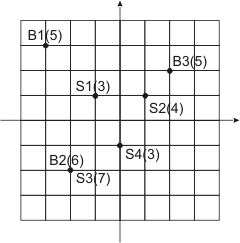 The City has a number of municipal buildings and a number of fallout shelters that were build specially to hide municipal workers in case of a nuclear war. Each fallout shelter has a limited capacity
in terms of a number of people it can accommodate, and there‘s almost no excess capacity in The City‘s fallout shelters. Ideally, all workers from a given municipal building shall run to the nearest fallout shelter. However, this will lead to overcrowding
of some fallout shelters, while others will be half-empty at the same time.
The City has a number of municipal buildings and a number of fallout shelters that were build specially to hide municipal workers in case of a nuclear war. Each fallout shelter has a limited capacity
in terms of a number of people it can accommodate, and there‘s almost no excess capacity in The City‘s fallout shelters. Ideally, all workers from a given municipal building shall run to the nearest fallout shelter. However, this will lead to overcrowding
of some fallout shelters, while others will be half-empty at the same time. Input
Output
Sample Input
3 4
-3 3 5
-2 -2 6
2 2 5
-1 1 3
1 1 4
-2 -2 7
0 -1 3
3 1 1 0
0 0 6 0
0 3 0 2
Sample Output
SUBOPTIMAL
3 0 1 1
0 0 6 0
0 4 0 1
#include<iostream>
#include<cstdio>
#include<cstring>
#include<deque>
#include<cmath>
#include<algorithm>
using namespace std;

const int MAXN = 210;
const int MAXM = 43000;
const int INF = 0x3f3f3f3f;

struct Edge
{
	int from, to, cap, next, cost;
};

Edge edge[MAXM];
int head[MAXN];
int prevv[MAXN];
int preve[MAXN];
int has[MAXN];
int senario[MAXN][MAXN];
int dist[MAXN];
int vis[MAXN];
int cntvis[MAXN];
int x[MAXN], y[MAXN], p[MAXN], q[MAXN];
int peo[MAXN], cap[MAXN];
int src, des, cnt;

void addedge( int from, int to, int cap, int cost )
{
	edge[cnt].from = from;
	edge[cnt].to = to;
	edge[cnt].cap = cap;
	edge[cnt].cost = cost;
	edge[cnt].next = head[from];
	head[from] = cnt++;

}

int SPFA( int n )
{
	deque<int> dq;
	bool inqueue[MAXN];
	memset( dist, INF, sizeof dist );
	memset( inqueue, 0, sizeof inqueue );
	memset( cntvis, 0, sizeof cntvis );
	memset( prevv, -1, sizeof prevv );
	memset( preve, -1, sizeof preve );
	dq.push_back( src );
	dist[src] = 0;
	inqueue[src] = 1;
	cntvis[src]++;

	while(!dq.empty( ))
	{
		int u = dq.front( );
		dq.pop_front( );
		inqueue[u] = 0;
		for(int i = head[u]; i != -1; i = edge[i].next)
		{
			int v = edge[i].to;
			if(edge[i].cap > 0 && dist[u] + edge[i].cost< dist[v])
			{
				dist[v] = dist[u] + edge[i].cost;
				prevv[v] = u;
				preve[v] = i;
				if(!inqueue[v])
				{
					inqueue[v] = 1;
					cntvis[v]++;
					if(cntvis[v] > n) return v;
					if(!dq.empty( ) && dist[v] <= dist[dq.front( )])
						dq.push_front( v );
					else
						dq.push_back( v );
				}
			}
		}
	}
	return -1;
}


void NegaCircle( int ne )
{
	memset( vis, 0, sizeof vis );
	int st = ne;
	while(1)
	{
		if(!vis[st])
		{
			vis[st] = 1;
			st = prevv[st];
		}
		else
		{
			ne = st;
			break;
		}
	}
	do
	{
		int from = prevv[st], to = st; //在负圈上增广
		if(from <= 100 && to > 100)	senario[from][to - 100]++;
		if(from > 100 && to <= 100)senario[to][from - 100]--;
		st = prevv[st];
	} while(st != ne);

}

int main( )
{
	int n, m, f, cost;
	while(cin >> n >> m)
	{
		memset( has, 0, sizeof has );
		memset( head, -1, sizeof head );
		cnt = 0;
		f = 0, cost = 0;
		src = 0, des = 205;
		for(int i = 1; i <= n; i++)
		{
			//cin >> x[i] >> y[i] >> peo[i];
			scanf( "%d%d%d", &x[i], &y[i], &peo[i] );
		}

		for(int i = 1; i <= m; i++)
		{
			//cin >> p[i] >> q[i] >> cap[i];
			scanf( "%d%d%d", &p[i], &q[i], &cap[i] );
		}

		for(int i = 1; i <= n; i++)
		{
			addedge( src, i, peo[i], 0 );
			addedge( i, src, 0, 0 );
		}

		int trans;

		for(int i = 1; i <= n; i++)
		{
			for(int j = 1; j <= m; j++)
			{
				scanf( "%d", &trans );
				senario[i][j] = trans;
				has[j] += trans;
				int c = abs( x[i] - p[j] ) + abs( y[i] - q[j] ) + 1;
				addedge( i, 100 + j, INF - trans, c );
				addedge( 100 + j, i, trans, -c );
			}
		}

		for(int i = 1; i <= m; i++)
		{
			addedge( 100 + i, des, cap[i] - has[i], 0 );
			addedge( des, 100 + i, has[i], 0 );
		}

		int st = SPFA( n + m + 2 );
		if(st == -1)
		{
			printf( "OPTIMAL\n" );
			continue;
		}
		else
		{
			NegaCircle( st );
			printf( "SUBOPTIMAL\n" );
			for(int i = 1; i <= n; i++)
			{
				for(int j = 1; j < m; j++)
				{
					printf( "%d ", senario[i][j] );
				}
				printf( "%d\n", senario[i][m] );
			}
		}

	}
	return 0;
}
解题报告 之 POJ2175 Evacuation Plan
原文:http://blog.csdn.net/maxichu/article/details/45420165